Gravitomagnetic Time Delay for Light Propagating through a Rotating Thin Shell
DOI:
https://doi.org/10.63512/sustjst.2025.1003Keywords:
GravitomagnetismTime delay; Light ray; Rotating body; Thin rotating shell; Prograde and retrograde motion; Gravitomagnetic clock effect.Abstract
Abstract
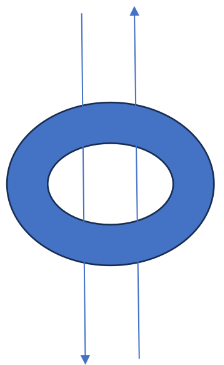
When a light ray passes through a slowly rotating thin shell of matter as well as moving in the exterior field of slowly rotating distant body, then the time of passage of the ray through the shell suffers a time delay which is called the gravitomagnetic time delay. In this article, we devise a simplified configuration of the problem where the light ray moves along a line that is parallel to the spin direction of the distant body and at the same time parallel to the axis of the thin shell but the ray does not go through the center of the thin shell. We calculate both the prograde and retrograde time delay of the light ray and find that gravitomagnetic time delay is positive for the prograde motion and negative for the retrograde motion of the light ray. That means the prograde motion takes longer time than the retrograde motion to cover the same distance. The result is analogous to that which happens in gravitomagnetic clock effect (GCE); the difference being that the motion in time delay considered here is straight line motion whence in GCE the point mass move along circular path around a rotating source. Although gravitomagnetic time delay is an old problem but the present work shed new light on this problem.
Downloads
Published
Issue
Section
License
Copyright (c) 2026 SUST Journal of Science and Technology (SUST JST)

This work is licensed under a Creative Commons Attribution 4.0 International License.