Analysis of Natural Regeneration and Vegetation Status of Tree Species of a Biodiversity Hotspot in Bangladesh
DOI:
https://doi.org/10.63512/sustjst.2025.2001Keywords:
Natural regeneration, tree species composition, biodiversity index, ecosystem, Rema-Kalenga Wildlife Sanctuary (RKWS)Abstract
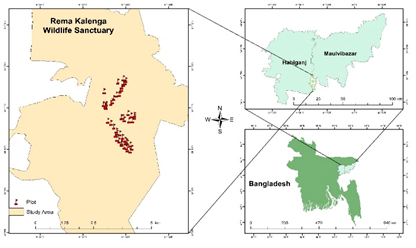
Natural regeneration is crucial for ecosystem restoration and sustainable forest growth. This study provides first comprehensive assessment of naturally regenerating tree species in the Rema-Kalenga Wildlife Sanctuary (RKWS), Bangladesh. Data was collected via systematic random sampling, using 50 plots (20m × 20m), each containing five 1m × 1m subplots, and totaling 250 subplots. The study found 859 individuals representing 67 identified species across 34 families, alongside 5 unidentified species. Among them, 774 individuals (63 species) were native, 24 individuals (4 species) were exotic, and 61 individuals remained 5 unidentified species. Moraceae was the most prevalent family (Family Importance Value = 23.11%) with Streblus asper emerging as the most prevalent dominant species (Important Value Index =19.71). Biodiversity indices revealed structural differences between native and exotic regeneration. Native species demonstrated high diversity, richness and evenness (Shannon-Wiener = 3.4540, Richness = 9.3211, Evenness = 0.8337), indicating a mature, stable ecosystem with high functional resilience and even distribution. Conversely, exotic species exhibit low richness and evenness but a paradoxically higher species diversity index (exotic 0.1667 vs. native 0.0814). This disparity reflects the extreme dominance of a few aggressive individuals, signaling an early-stage invasion risk capable of gradually displacing native flora despite the current limited abundance of exotic species. These findings offer crucial baseline insights into the sanctuary’s current vegetation status. Ultimately, this study provides a vital scientific foundation for selecting appropriate tree species for future afforestation initiatives and sustainable conservation management strategies within the RKWS.
Downloads
Published
Issue
Section
License
Copyright (c) 2026 SUST Journal of Science and Technology (SUST JST)

This work is licensed under a Creative Commons Attribution 4.0 International License.