Predicting At-Risk Primary Students in Sylhet, Bangladesh: Grading Artifacts,Half-Yearly Signals, and the Class 3 Failure Breakpoint
DOI:
https://doi.org/10.63512/sustjst.2025.2005Keywords:
at-risk prediction, conjunctive grading, early warning systems, machine learning, primary education, curriculum transitionAbstract
Primary school failure statistics in low- and middle-income countries are often reported without distinguishing between students who fail broadly and those who fail a single subject under conjunctive grading rules that collapse all failure into one label. This paper reports findings from a multi-institutional study of 4,632 primary school students (Classes 1–5) across nine schools in Sylhet,
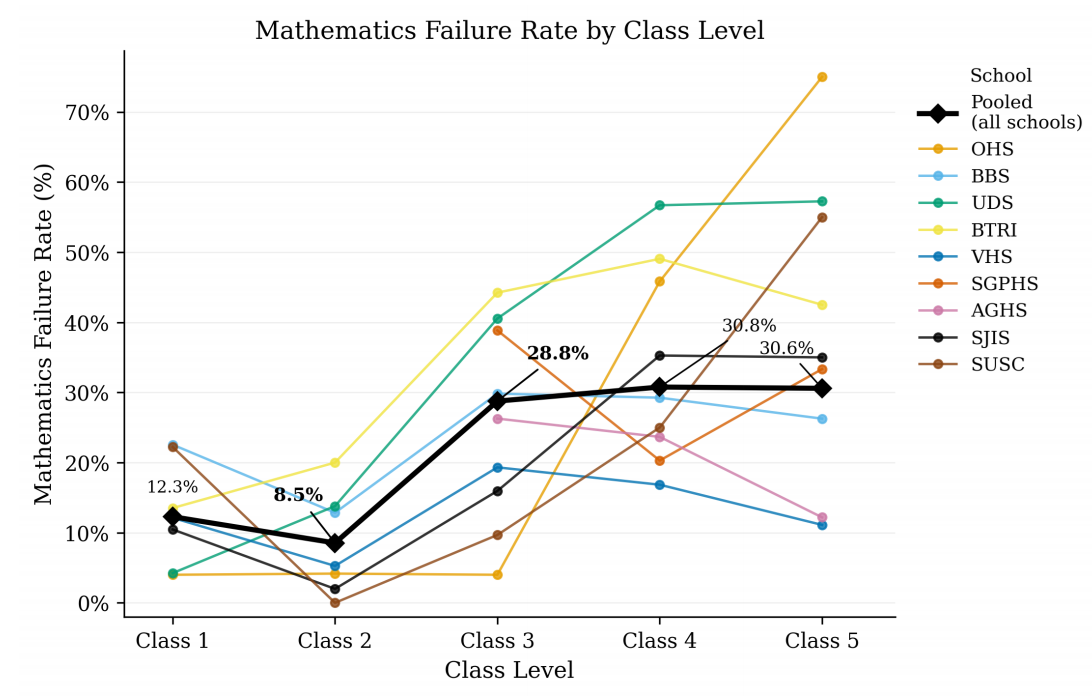
Bangladesh, spanning government, institutional, private, Islamic, girls-only, and university affiliated institutions. Three questions guide the analysis. First, can half-yearly examination records reliably identify students who will remain at risk by year-end, and which features carry the strongest predictive signal? Second, what share of students recorded as failing have failed only one subject under a rule that assigns GPA = 0 regardless of how many subjects a student actually fails? Third, does the sharp increase in Mathematics failure at Class 3 replicate independently across different types of schools which points to the national curriculum as the primary driver rather than any individual school factor? Across cohort years, an XGBoost classifier trained on one year’s records sustains 74.9% at-risk recall when applied to the following year. Within the same year, Random Forest achieves 88.8% accuracy (AUC = 0.928) under cross-validation, reducing false-alarm interventions by 65% compared with the existing half-yearly flagging approach. An analysis of GPA = 0 records shows that 38.3% of the students had single-subject failures. Mathematics
was the failed subject in 55.5% of these cases. Class 3 Mathematics failure rates jumped from 8.5% to 28.8% across the sampled schools. This pattern suggests a shared curriculum-related transition rather than a school-specific factor. The findings suggest two possible responses: a school-deployable early warning system using existing mid-year records and a policy reform replacing the conjunctive grading rule with a compensatory calculation that would reclassify approximately 38% of current GPA = 0 students without changing their actual performance.
Downloads
Published
Issue
Section
License
Copyright (c) 2026 SUST Journal of Science and Technology (SUST JST)

This work is licensed under a Creative Commons Attribution 4.0 International License.